
September 24, 2026

1 Session, 3 hours 30 minutes
(Online Webinar)
8:30am-12pm (Login begins at 8:15am)
Registration Fee: $275-$300
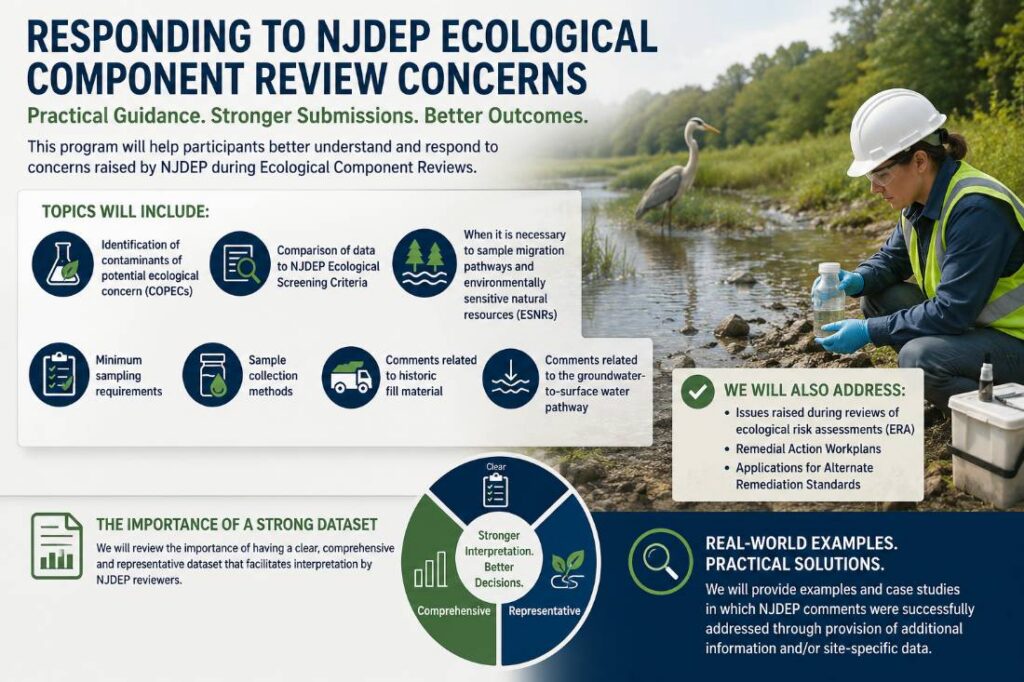
This program will help participants better understand and respond to concerns raised by NJDEP during Ecological Component Reviews.
Topics will include identification of contaminants of potential ecological concern (COPECs), comparison of data to NJDEP Ecological Screening Criteria, when it is necessary to sample migration pathways and environmentally sensitive natural resources (ESNRs), minimum sampling requirements, sample collection methods, comments related to historic fill material, and comments related to the groundwater-to-surface water pathway.
We will also touch on issues raised during reviews of ecological risk assessments (ERA), Remedial Action Workplans, and applications for Alternate Remediation Standards.
Lastly, we will review the importance of having a clear, comprehensive and representative dataset that facilitates interpretation by NJDEP reviewers. We will provide examples and case studies in which NJDEP comments were successfully addressed through provision of additional information and/or site-specific data.

Instructor:

Continuing Education Credits:
- NJ LSRP CEC’s: Pending
- NJ Continuing Legal Education: Pending
- NJ Professional Engineers: Pending
- ATTENTION HEALTH OFFICERS AND REGISTERED ENVIRONMENTAL HEALTH SPECIALISTS: Pending
Mr. Yates has 13 years of experience conducting Ecological Evaluations and Ecological Risk Assessments under NJDEP Site Remediation Program requirements. He uses federal and state-approved methods and tools to assess exposure and risk to various benthic, fish and wildlife species and develop site-specific ecological cleanup standards.
Mr. Yates has conducted extensive research on the life history of various wildlife “indicator species” including exposure through soil/sediment ingestion as well as dietary exposure through bioaccumulation. He has developed multi-compartmental models for assessing the bioaccumulation and biomagnification of chemicals of concern up the food chain throughout multiple trophic levels and feeding guilds.
Brian is currently the lead technical scientist in charge of developing ecological clean-up levels for the Texas Commission on Environmental Quality’s “Protective Concentration Level (PCL) Database”, which includes over 130 chemicals of concern, 79 species and three toxicological endpoints. He has conducted ecological risk assessments of various chemical mixtures in sediments, soils, and surface waters in diverse habitats and ecosystems across the United States.
Mr. Yates has conducted extensive sampling and analysis of water quality, including investigations on the causes of freshwater harmful algal blooms. He has overseen the collection of macroinvertebrate, earthworm, fish, small mammal, and plant tissue sampling, sediment toxicity testing, benthic macroinvertebrate surveys, pore water analyses, food chain modeling, and combined multiple lines of evidence to reach “weight of evidence” conclusions regarding ecological risks.
Call 732-907-7269 or Contact Us With Questions or to Learn More
Back to a complete list of All Courses